
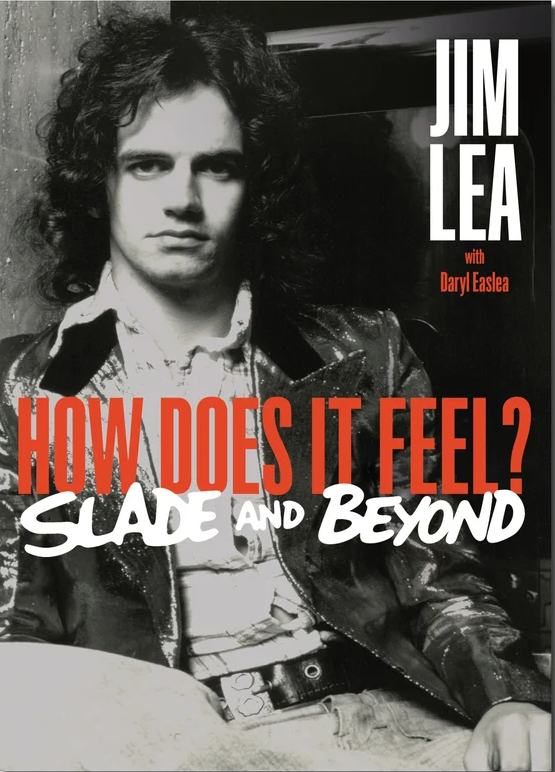
JIM LEA with DARYL EASLEA – How Does It Feel? Slade and Beyond
- Posted on 10-09-2026
RELEASE YEAR: 2026
BAND URL: https://omnibuspress.com/products/how-does-it-feel-the-jim-lea-autobiography
While renowned British rockers Slade are the stuff of legend and the very definition of cool in so many ways, one of its principial songwriters and sonic architects, namely bass player extraordinaire Jim Lea, seemingly always thrived in the background and was rarely the center of attention, nor did he desire the limelight, for that matter. To some fans and observers of the band that made him all the more intriguing. Composed by the talented Daryl Easlea and Lea himself, How Does It Feel? casts an illuminating light on this most captivating of musicians and reluctant rock ‘n’ roll stars.
Lea’s tale is primarily told through very short chapters and several one- or two-page entries, or vignettes, if you will, with a singular theme and focus to them. In that sense, the book is ideal for bedtime reading or even a short train ride due to the short, concise nature of it all. Even though some entries are infinitely more interesting and noteworthy than others, there is a lot of entertaining trivia, obscure facts, and funny details hidden within those texts, and they generally make for an enjoyable read and fit well into a busy day as they add a quick sense of progress to the memoir. While some appear somewhat random with respect to subject matter, others serve a greater purpose within the overall storyline and tie in with Lea’s personal history on many levels and in different ways. There is undoubtedly a huge charm to the idea of composing a non-linear narrative in such a manner in order to sum up his experiences and achievements in music and outside of it, for what is the life of a musically gifted individual if not unconventional?! Said method also infuses the book with a certain vibrancy that makes the events and characters that populate it come alive. On the flipside, its structure occasionally undermines the flow of the main story and kills its momentum stone dead, and there are times when it fails to gel as a cohesive written account.
Lea vividly relays what transpired within Slade, motstly with respect to the tours and recording sessions, and his distinct tone is the main draw of How Does It Feel? There is a subtle yet fascinating dichotomy at play throughout the book that revolves around Lea’s pride in what Slade achieved and the actual quality of their compositions on the one side and then his reluctance to partake in everything associated with the rock ‘n’ roll lifestyle on the other. In many respects, he was just like Jeff Lynne of ELO fame; rock ‘n’ roll clichés and shenanigans were never of much interest to him and next to no appeal. There are several highlights throughout, including copies of the many letters he wrote to his childhood sweetheart (and later wife) indicating just how lonely and tiresome the road could be, a meeting with the infamous Kim Fowley that led to pre-Slade outfit the ’N Betweens recording a lackluster single titled “You Better Run) at the legendary Regent Sound Studios in London, socially awkward and rather embarrassing encounters with Ringo Starr and David Bowie, and how the aforementioned ’N Betweens transformed into Ambrose Slade in the late sixties and then eventually settled on the name Slade and began their musical conquest.
How Does It Feel? is easily digestible, albeit a slightly uneven affair that does not always manage to conjure up a genuine sense of excitement or strong emotion in the reader. Its inviting British wit is irresistible, as is Lea’s way of summing up the bygone eras of the fifties and sixties, and it is incredibly inspiring to see and hear just how proud of his abilities and achievements he is, but it also comes across as slightly too safe in places in that it only scratches the surface of certain topics rather than penetrating to the very core of them and laying everything bare. With respect to the dynamics and way of communicating within Slade, or lack thereof, as it were, one is left feeling that there is infinitely more to the story than what is divulged here. Although a good accompaniment to the remarkable Whatever Happened to Slade? by Easlea (Omnibus Press, 2024), this 2026 offering is simply a good, pleasant, and oftentimes fun read rather than an essential or decidedly riveting one.